
AI Workflows for GTM Teams: 6 Takeaways from Our Breakfast Workshop
.JPG/v1/fill/w_320,h_320/file.jpg)
That's a wrap, people!
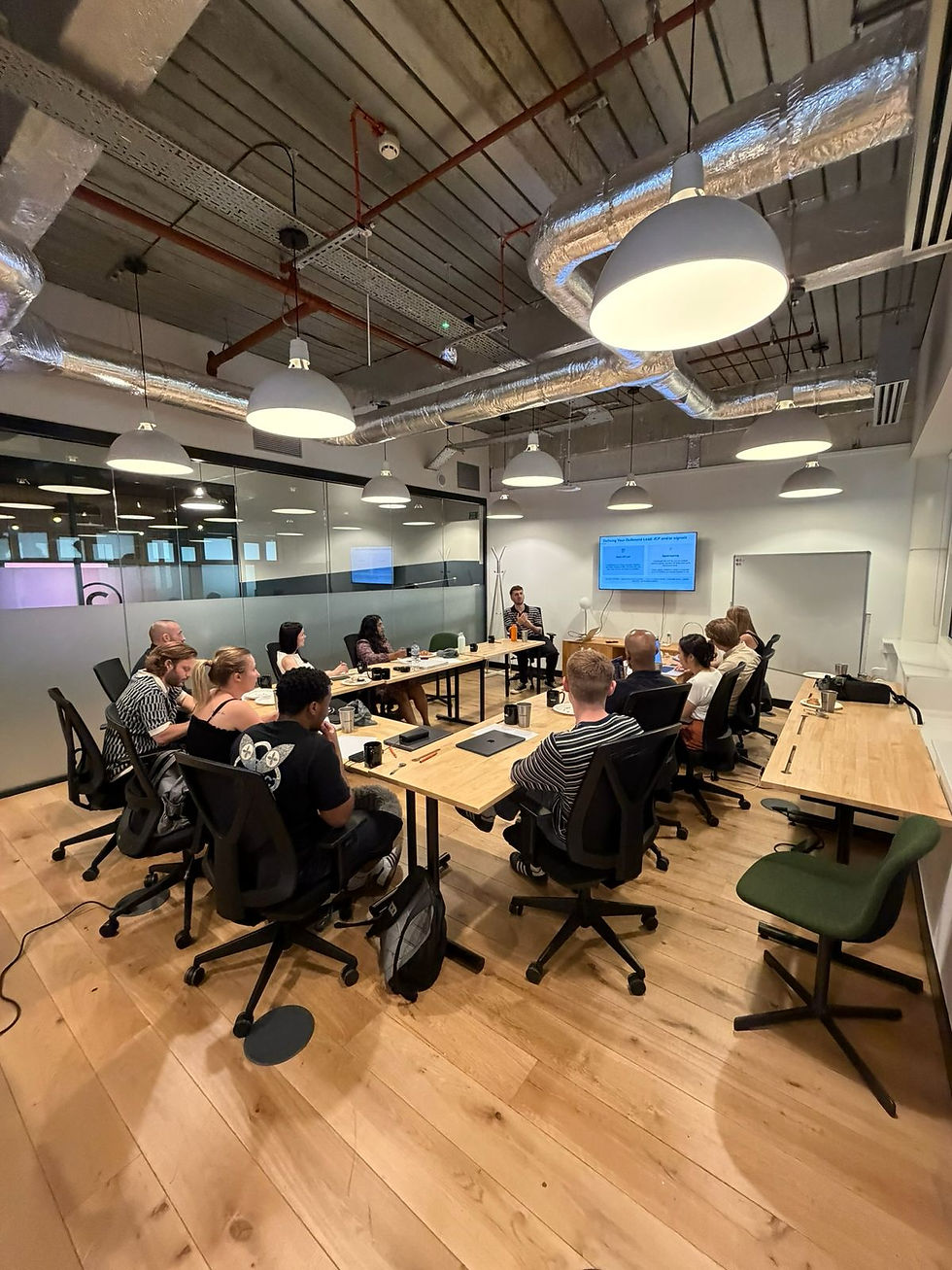
A huge THANK YOU to everyone who joined us for our first breakfast workshop, AI Workflows for GTM Teams.
Over croissants and coffee, we tackled one of the biggest challenges for GTM teams right now:
Where does AI genuinely improve the way we work, and where does it simply add another layer of tooling?

Every week, new features launch across the platforms we know and love, giving us multiple ways to solve the same problem. That's exciting, but it also makes it difficult to know where to spend your time.
So rather than talking about AI in general, we focused on the workflows behind it and where AI can genuinely improve them.
Here are our top five takeaways from the session:
Takeaway #1: Start with the problem
One of the first things we spoke about was how much GTM roles have changed over the last few years.
Tasks that once needed technical expertise are now much more accessible, meaning more teams can build workflows around things like lead enrichment, personalisation and lead scoring.
But with more ways to build comes more decisions about where to start.
It's tempting to ask, "Can we do this with ChatGPT?" or "Should we build this in Claude?" However, before choosing a tool, you first need to understand the problem you're trying to solve.
For example:
Is your inbound qualification too slow?
Are leads being routed incorrectly?
Are SDRs spending hours researching prospects?
Is forecasting unreliable?
Every company has different bottlenecks, which means every company will build slightly different workflows.
One example we walked through followed an inbound lead from form submission through enrichment, qualification and routing. Rather than replacing the existing process, AI was introduced at different points to remove manual work and help the process move a little faster.
Takeaway #2: Use each tool for what it does best
Once you've identified the workflow, the next question is how to build it.
One of the examples we looked at was inbound lead enrichment. When a new lead comes into your CRM, you often know very little about them. Before you can score or route that lead, you need more context.

We walked through several approaches using HubSpot, Apollo, Clay, Zapier and different LLMs, each playing a different role within the same workflow.
In one example, Apollo handled the initial enrichment before Claude researched the account further and created a meeting-ready brief for the sales team.
In another, HubSpot enriched company data before AI classified free-text location fields into routing regions, helping route enquiries more accurately.
One thing that came up several times was that no single tool does everything well. The best workflows combine different approaches depending on the task.
That also means using simpler enrichment where you can, and bringing AI in where it adds something extra. It's often quicker, more cost-effective and much easier to maintain over time.
Takeaway #3: Build the process before adding more intelligence
As the workshop moved into lead scoring and routing, the conversation shifted to what happens after enrichment.
By this stage, your CRM has the information it needs. The next question is what you do with it. Should the lead be scored? Who should own it? And how quickly should someone follow up?
The workshop compared AI scoring with traditional rules-based scoring. If you already have a well-defined ICP, straightforward routing rules and limited historical data, a rules-based approach is often easier to maintain and trust.
AI scoring becomes more useful once those conditions start to change. Larger datasets and more complex buying patterns can be difficult to capture with fixed rules alone.
The same principle applies to routing. If simple rules will get the lead to the right person quickly, they're often the better option. Sales teams also need to understand why a lead has landed with them.
The practical recommendation was to start with a small number of clear scoring criteria and routing rules, then build from there as your data grows.
Takeaway #4: Layer signals, don't rely on one
The workshop then moved on to outbound and how teams decide who to prioritise.
Most businesses already have a clear idea of who their ideal customer is. The next step is understanding what else is happening around those accounts.
We looked at examples including job changes, funding announcements, hiring activity, website visits, social mentions and changes to a company's tech stack.
On their own, each signal tells you something different. The workshop showed how they can be combined into a composite score beneath a static ICP list, giving Sales more context when prioritising accounts.
Which signals matter most will depend on your business. A company selling to fast-growing startups might prioritise funding announcements and hiring activity, while others may place more value on website visits or technology changes.
Like the earlier workflows, the recommendation wasn't to build everything at once. Start with the signals that matter most to your business, then build your outbound process over time.
Takeaway #5: AI agents have a role to play
Next, we spoke about AI agents and where they fit into a modern GTM team.
Many of the examples focused on individual parts of the outbound workflow. Research, enrichment, first-line personalisation, follow-up sequences and qualification are all areas where AI can save time.
One workflow followed a lead from an ICP or buying signal through enrichment in Clay or Apollo, into AI-generated personalisation, before being reviewed by an SDR, sent, and automatically logged back into the CRM.
We also looked at the growing number of AI SDR platforms now available, including:
Amplemarket
Artisan
11x
Cognism
Each takes a slightly different approach, whether that's prospecting, outreach, sequencing or combining multiple stages of the workflow into a single platform.
The workshop also touched on self-built agents. These can work well for repetitive, high-value workflows where off-the-shelf tools don't quite fit.
They also come with ongoing maintenance, model updates and security considerations, so they're generally better suited to teams with an established process and the resource to support them.
Takeaway #6: Your CRM is more than a database
By this point in the workshop, the focus shifted from individual workflows to where CRM platforms are heading.
Rather than acting as passive databases, they're becoming more active intelligence layers that help teams spot patterns, identify pipeline risks and answer questions using live CRM data.
One example showed AI sitting on top of the CRM to analyse deals, summarise pipeline health and surface issues that might otherwise be missed.
The catch is that this only works well when the underlying data is structured. Instead of giving AI access to everything in the CRM, the recommendation was to define exactly which fields it should use.
That keeps responses more consistent, reduces costs and makes the outputs easier to trust.
Ultimately, AI is only as useful as the data you give it.
Final thoughts
Although the examples changed throughout the workshop, the advice stayed largely the same.
Get the basics right first. Build processes people understand. And add AI where it improves the workflow, not just because the technology exists!
It's an approach that's easier to implement and maintain, and far more likely to deliver results over time.
See you next time!
A huge thank you again to everyone who joined us for another brilliant Breakfast Workshop. It was great to see so many GTM, RevOps and Sales leaders sharing ideas, comparing workflows and asking thoughtful questions throughout the morning.
We hope everyone left with a few practical ideas they can start experimenting with straight away, and we look forward to seeing you at the next Sessions with scale event.


Comments